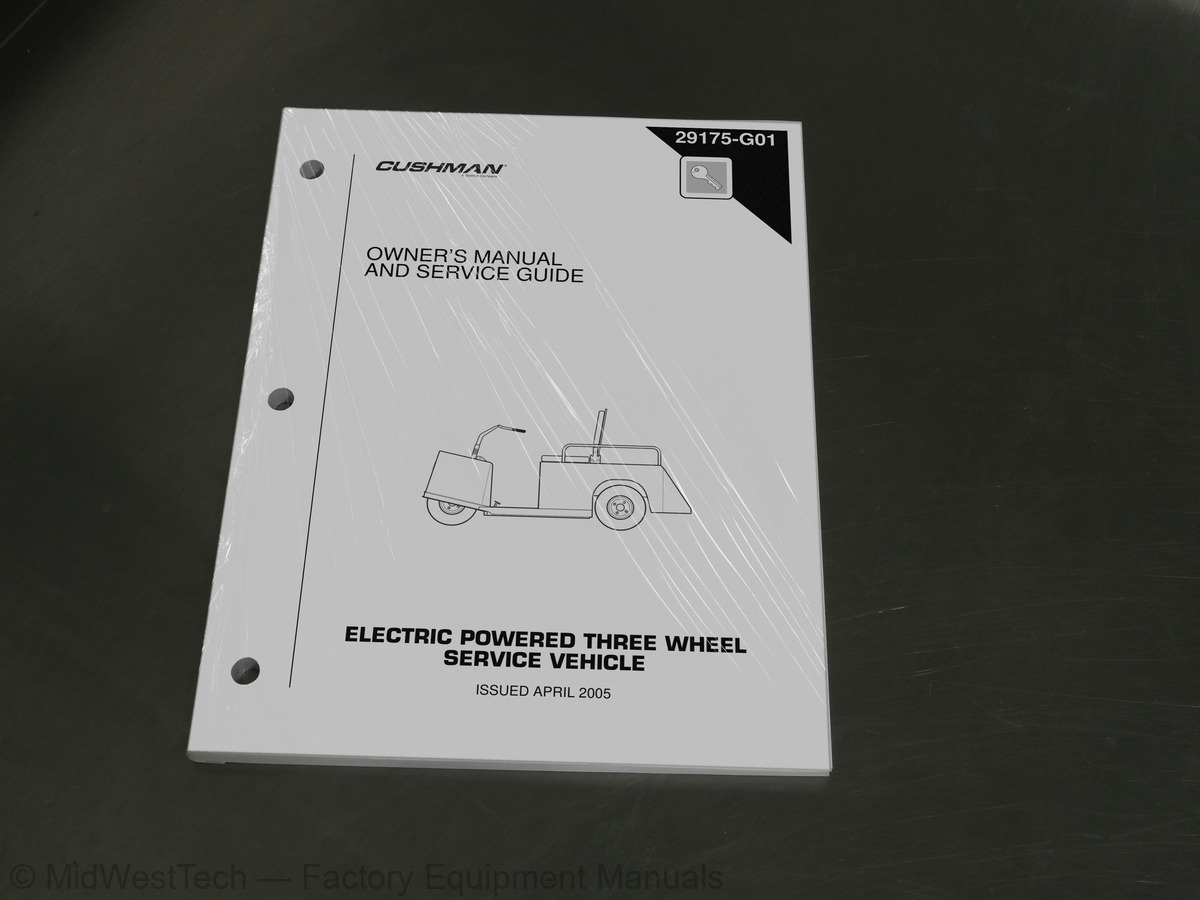
Cushman Minute Miser Electric 3 Wheel Vehicle Operator's Manual
50 pages · Publication 29175-G01
Added to your cart. View cart
- Models
- Minute Miser
- Serial coverage
- Starting Model Year 2004
- Manual type
- Operator's Manual
- Pages
- 50
- Publication
- 29175-G01
- Condition
- Brand new
What's inside
From the manual's own table of contents: 12 sections, 167 entries. See sample pages (PDF, 403 KB)
ELECTRIC POWERED THREE WHEEL SERVICE VEHICLE2 topics
- OWNER’S MANUAL
- AND SERVICE GUIDE
CoverWarnElec.pdf4 topics
- NOTES, CAUTIONS AND WARNINGS
- A NOTE indicates a condition that should be observed
- Read and understand the following warnings before attempting to operate the vehicle
- Read and understand the following text and warnings before attempting to service vehicle
pgs i-ii-ModelsNotes.pdf10 topics
- ELECTRIC POWERED
- THREE WHEEL
- SERVICE VEHICLE
- Starting Model Year 2004
- BATTERY PROLONGED STORAGE
- All batteries will self discharge over time. The rate of self discharge varies depending on the ambient temperature and
- A fully charged battery will not freeze in winter temperatures unless the temperature falls below -75° F (-60° C)
- For winter storage, the batteries must be clean, fully charged and disconnected from any source of electrical drain, suc
- As with all electric vehicles, the batteries must be checked and recharged as required or at a minimum of 30 day interva
- Refer to the ‘Prolonged Storage’ section within the BATTERIES AND CHARGING section of this manual
pgs v-viiiSafetyInfoElec.pdf4 topics
- GENERAL
- GENERAL OPERATION
- MAINTENANCE
- VENTILATION
GENERAL SAFETY PRACTICES11 topics
- Introduction
- Stability
- (a) The user shall train carrier operators to adhere strictly to the operating instructions stated in this Standard
- (b) The user shall survey specific operating conditions and environment, and establish and train carrier operators to co
- Nameplates, Markings, Capacity, and Modifications
- Fuel Handling and Storage
- Changing and Charging Storage Batteries for Electric Personnel and Burden Carriers
- Hazardous Locations
- Lighting for Operating Areas
- Control of Noxious Gases and Fumes
- Warning Device(s)
OPERATING SAFETY RULES AND PRACTICES12 topics
- Personnel and Burden Carrier Operator Qualifications
- Personnel and Burden Carrier Operator’s Training
- (a) instructional material provided by the manufacturer
- (b) emphasis on safety of passengers, material loads, carrier operator, and other employees
- (c) general safety rules contained within this Standard and the additional specific rules determined by the user in acco
- (d) introduction of equipment, control locations and functions, and explanation of how they work when used properly and
- (e) operational performance tests and evaluations during, and at completion of, the program
- Personnel and Burden Carrier Operator Responsibility
- General
- Traveling
- Loading
- Operator Care of Personnel and Burden Carriers
MAINTENANCE PRACTICES21 topics
- Introduction
- Maintenance Procedures
- (a) A scheduled preventive maintenance, lubrication, and inspection system shall be followed
- (b) Only qualified and authorized personnel shall be permitted to maintain, repair, adjust, and inspect carriers
- (c) Before undertaking maintenance or repair, follow the manufacturer’s recommendations for immobilizing the carrier
- (d) Block chassis before working underneath it
- (e) Before disconnecting any part of the engine fuel system of a gasoline or diesel powered carrier with gravity feed fu
- (f) Before disconnecting any part of the engine fuel system of LP gas powered carriers, close the LP gas cylinder valve
- (g) Operation to check performance of the carrier shall be conducted in an authorized area where safe clearance exists
- (h) Before commencing operation of the carrier, follow the manufacturer’s instructions and recommended procedures
- (i) Avoid fire hazards and have fire protection equipment present in the work area. Do not use an open flame to check le
- (j) Properly ventilate the work area
- (k) Handle LP gas cylinders with care. Physical damage, such as dents, scrapes, or gouges, may dangerously weaken the ta
- (l) Brakes, steering mechanisms, speed and directional control mechanisms, warning devices, lights, governors, guards, a
- (m) Special carriers or devices designed and approved for hazardous area operation shall be inspected to ensure that mai
- (n) Fuel systems shall be checked for leaks and condition of parts. If a leak is found, action shall be taken to prevent
- (o) The carrier manufacturer’s capacity, operation, and maintenance instruction plates, tags, or decals shall be maintai
- (p) Batteries, motors, speed and directional controllers, limit switches, protective devices, electrical conductors, and
- (q) Carriers shall be kept in a clean condition to minimize fire hazards and facilitate detection of loose or defective
- (r) Modifications and additions which affect capacity and safe machine operation shall not be performed by the customer
- (s) Care shall be taken to ensure that all replacement parts are interchangeable with the original parts and of a qualit
Text.pdf87 topics
- STANDARDS AND PUBLICATIONS
- Standards
- Publications
- BEFORE INITIAL USE
- Fig. 1 Initial Service Chart
- On Board Charger
- IDENTIFICATION
- Fig. 2 Model Number, Model Year and Serial Number
- Fig. 3 Serial Numbers Under Seat
- CONTROLS, METERS AND SWITCHES
- Fig. 4 Controls On Dashboard
- Key Switch
- Direction Selector Switch
- Power On/Battery Condition Meter
- Headlight Switch
- Service/Parking Brake Pedal
- Speed Control Pedal
- Handlebar
- Horn
- Key Switch
- Direction Selector Switch
- Power ON/Battery Condition Meter
- Headlight (Accessory)
- Service/Parking Brake Pedal
- Speed Control Pedal
- Horn and Handlebar
- Handlebar Installation
- Seat Switch
- Hour Meter (Accessory)
- ADDITIONAL FEATURES
- Battery Charger
- Fold Down Backrest
- Programmable Speed Controller
- EE UNITS
- BEFORE ENTERING VEHICLE
- Check for correct tire inflation
- Inspect for fluid leaks
- Be sure everything is properly stored and secured
- OPERATING THE VEHICLE
- STARTING THE VEHICLE
- When the direction selector is in the reverse position, a warning signal will sound. This is a device to indicate the ve
- COASTING
- OPERATION
- DRIVING THE VEHICLE
- If the selector is moved to the REVERSE position, a backup warning alarm will sound until the vehicle is again placed in
- SERVICING THE ELECTRIC VEHICLE
- TOWING
- LIFTING THE VEHICLE
- Fig. 13 Lifting the Vehicle
- SAFETY COMPONENTS
- Seat Switch
- Thermal Circuit Breaker
- Parking The Vehicle
- ROUTINE MAINTENANCE
- Some maintenance items must be serviced more frequently on vehicles used under severe driving conditions
- REAR AXLE
- Checking the Lubricant Level
- BRAKES
- Fig. 17 Periodic Brake Performance Test
- Test Method
- TIRES
- Tire Repair
- Wheel Installation
- LIGHT BULB REPLACEMENT
- CARE AND CLEANING OF THE VEHICLE
- TRAILERING
- HARDWARE
- Fig. 20 Bolt Grades
- TORQUE SPECIFICATIONS
- Fig. 21 Torque Specifications
- PERIODIC SERVICE SCHEDULE
- Fig. 22 Periodic Service Schedule
- BATTERIES AND CHARGING
- Safety
- BATTERY
- BATTERY MAINTENANCE
- At Each Charging Cycle
- Monthly
- Electrolyte Level and Water
- Cleaning Batteries
- Battery Replacement
- Prolonged Storage
- Battery Charging
- AC Voltage
- TROUBLESHOOTING
- Hydrometer
- Using A Hydrometer
GenSpecsEZGOCushman.pdf4 topics
- GENERAL SPECIFICATIONS
- ELECTRIC POWERED THREE WHEEL SERVICE VEHICLE
- Fig. 33 Vehicle Dimensions and Incline Specifications
- Fig. 34 Vehicle Turning Clearance Diameter and Intersecting Aisle Clearance
Inside this manual
Real pages from this operator's manual (50 pages). Open the sample pages (PDF, 402 KB)

- Maintenance, page 16: SAFETY INFORMATION
- Controls and operation, page 23: Drive the vehicle only as fast as terrain and safety
- Specifications, page 47: GENERAL SPECIFICATIONS
This is an operator's manual
Here's how it compares to the other manual types.
Service manual
Factory repair procedures and technical information such as specifications, troubleshooting, and wiring and hydraulic diagrams, for the models and systems the manual covers. See What's inside for its topics.
Operator's manual
Safe operation, controls, maintenance schedules, lubrication points, inspections, and basic checks. Repair procedures are in the service manual.
Parts manual
Illustrated diagrams with factory part numbers for identifying components and ordering parts. Repair procedures are in the service manual.
What it's used for
Factory manual for in-house farm and construction shop use. Straightforward, complete, and easy to follow. It contains the OEM information dealership service departments and parts counters use to diagnose problems, identify components, and perform maintenance or repairs correctly.
Service shops and owner/operators who repair their own equipment
Identifying correct parts and seeing how assemblies come apart and go back together
Keeping equipment running with less downtime
Factory manual, 50 pages
Quantity one is the manual described above.
Fast free USA shipping
Ships in 1 business day.
60-day returns
Free if the mistake is ours. A manual ordered in error must come back unopened in its shrink-wrap; you pay return shipping and a 20% restocking fee applies. Return policy
Questions about model, serial number, engine coverage or contents? Contact us before purchasing and we'll help confirm it's the right manual. Please verify the manual type, machine model, serial number range and engine coverage before purchasing: manuals ordered in error carry a 20% restocking fee (return policy).