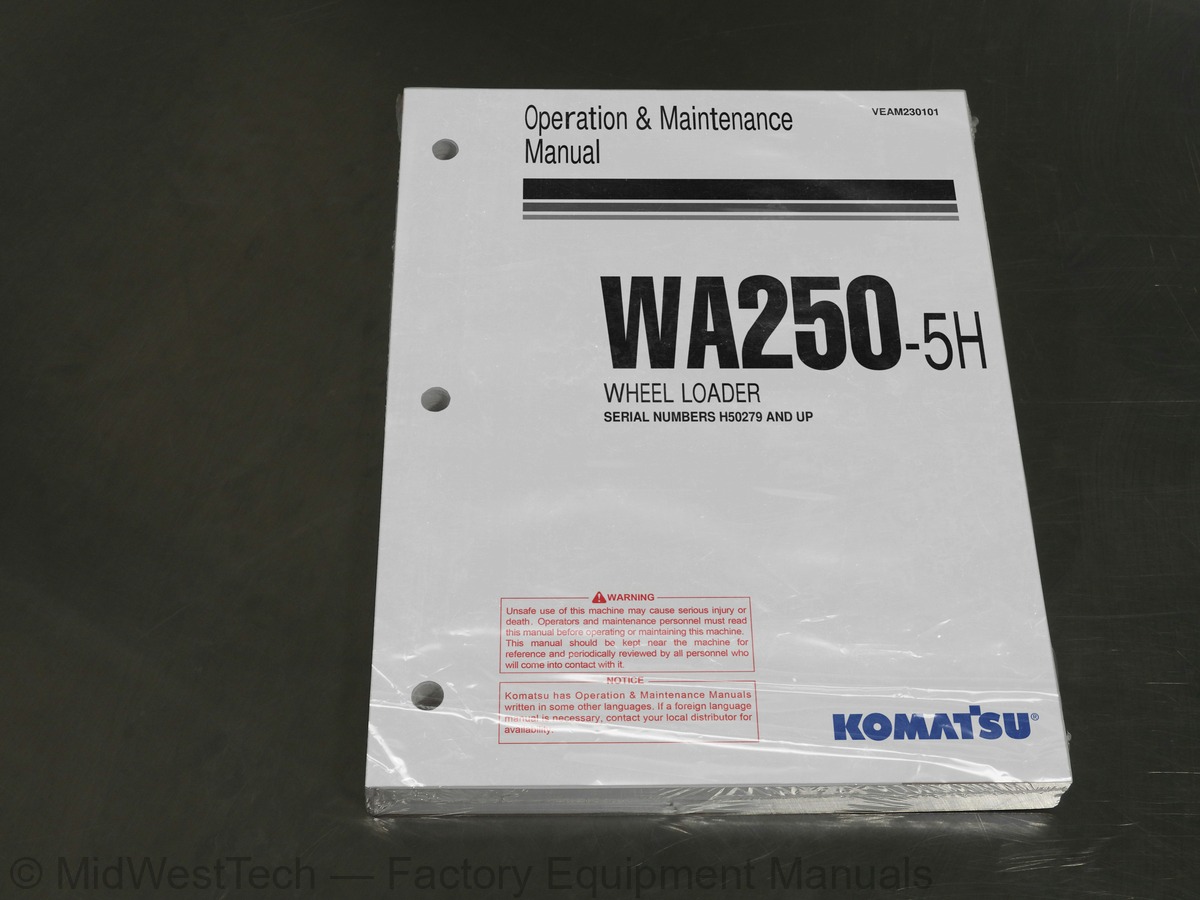
Komatsu WA250-5H Wheel Loader Operation & Maintenance Manual
246 pages · Publication VEAM230101
Added to your cart. View cart
- Models
- WA250-5H
- Serial coverage
- H50279 and up
- Manual type
- Operation & Maintenance Manual
- Pages
- 246
- Publication
- VEAM230101
- Condition
- Brand new
What's inside
From the manual's own table of contents: 25 sections, 241 entries. See sample pages (PDF, 457 KB)
Introduction2 topics
- Intended use
- Directions of machine
Necessary information8 topics
- PIN Machine serial No. plate and position
- Engine serial No. plate and position
- ROPS/FOPS-cab serial no. plate
- Axle serial no. plate
- Transmission serial no. plate
- Seat operator serial no. plate
- Position of service meter
- Table to enter serial No. and distributor
Dimensions, weights and operating data1 topic
- WA250-5H: Dimensions, weights and operating data
CE-conforming equipment1 topic
- Manufacturer-supplied CE-conforming equipment, according to document 421-93-H1900
Safety labels2 topics
- Location of safety labels
- Presentation of safety labels
General precautions1 topic
- Safety rules
Precautions for operation5 topics
- Starting engine
- Operation
- Transportation
- Battery
- Towing
Precautions for maintenance1 topic
- Safety instructions
Precautions with tires2 topics
- Handling tires
- Precautions when storing tires
General view2 topics
- General view of machine
- General view of controls and gauges
Explanation of components69 topics
- Machine monitor
- Monitor system
- Types of warning
- Character display portion
- Emergency stop item
- Caution items
- Warning/limit functions for travel speed
- Inspection and maintenance item
- Pilot display portion
- Meter display portion
- Other functions of machine monitor
- Switches
- Control levers, pedals
- Steering tilt lock lever
- Cap and cover with lock
- Safety bar
- Towing pin
- Grease pump
- Cab door inner lock
- Cab door open lock
- Cab window open lock cancel knob
- Fuse
- Fuse capacity and name of circuit
- Slow blow fuse
- Power outlet
- Air conditioner
- General locations and function of control panel
- Method of operation
- Precautions when using
- Handling cab wiper
- Preventing damage to wiper arm bracket
- Check before starting engine, adjust
- Walk-around check
- Check before starting
- Adjustment
- Operations and checks before starting engine
- Operations and checks after starting engine
- Breaking-in the machine
- Normal operation
- Stopping engine
- Moving the machine (Directional, speed), stopping the machine
- Moving the machine
- Changing direction
- Stopping the machine
- Turning
- Emergency steering
- Operation of work equipment
- Work possible using wheel loader
- Digging operations
- Leveling operations
- Pushing operation
- Load and carry operations
- Loading operations
- Precautions for operation
- Permissible water depth
- If wheel brake does not work
- Precautions when driving up or down slopes
- Adjusting work equipment posture
- Adjusting boom kickout
- Adjusting bucket positioner
- Bucket level indicator
- Parking machine
- Check after stopping engine
- Checks after completion of operation
- Locking
- Handling the tires
- Precautions when handling tires
- Tire pressure
- Precautions for using load and car method
Transportation9 topics
- Transportation procedure
- Loading, unloading work with trailers
- Loading
- Securing machine
- Unloading
- Lifting machine
- Location of lifting position mark
- Weight table
- Lifting procedure
Cold weather operation6 topics
- Precautions for low temperature
- Fuel and lubricants
- Coolant
- Precautions after completion of work
- After cold weather
- Warming-up operation for steering hydraulic circuit in cold weather
Long-term storage3 topics
- Before storage
- During storage
- After storage
Troubleshooting12 topics
- When machine runs out of fuel
- Towing the machine
- When engine can be used
- When engine cannot be used
- If battery is discharged
- Removal and installation of battery
- Precautions for charging battery
- Starting engine with booster cable
- Other trouble
- Electrical system
- Chassis
- Engine
Outlines of service79 topics
- Handling oil, fuel, coolant and performing oil clinic
- Fuel
- Grease
- Carrying out KOWA (Komatsu Oil Wear Analysis)
- Storing oil and fuel
- Filters
- Biodegradable hydraulic oil and lubricants
- Outline of electric system
- Wear parts
- Wear parts list
- Fuel, coolant and lubricants
- Lubrication chart
- Proper selection of fuel, coolant and lubricants
- Standard tightening torques for bolts and nuts
- Torque list
- Periodic replacement of safety critical parts
- Safety critical parts
- Maintenance schedule chart
- Service procedure
- Initial 50 hours service (only after the first 50 hours)
- Check for loose wheel hub bolts, tighten
- Initial 250 hours service (only after the first 250 hours)
- When required
- Check, clean, or replace air cleaner element
- Dust pre-extractor "Turbo II": check, clean
- Clean inside of cooling system
- Check oil level in transfer case, add oil
- Check axle oil level, add oil
- Clean axle case breather
- Clean air conditioner condenser
- Check window washing fluid level, add fluid
- Clean radiator fins and cooler fins
- Clean transfer oil cooler fins
- Check electrical intake air heater
- Replace bolt on cutting edge
- Replace bucket teeth
- Check air conditioner
- Replace slow blow fuse
- Selection and inspection of tires
- Check before starting
- Every 50 hours service
- Drain water, sediment from fuel tank
- Every 100 hours service
- Lubricate rear axle pivot pin
- Clean element in air conditioner fresh air filter
- Check oil level in hydraulic tank, add oil
- Every 250 hours service
- Check battery electrolyte level
- Check parking brake
- Check air conditioner compressor belt tension, adjust
- Check for loose wheel hub bolts, tighten
- Clean element in air conditioner recirculation filter
- Lubricating
- Every 500 hours service
- Change oil in engine oil pan, replace engine oil filter cartridge
- Replace fuel filter cartridge
- Clean water separator strainer
- Every 1000 hours service
- Change oil in transfer case
- Clean transfer case breather
- Replace HST oil filter element
- Lubricating
- Check tightening parts of turbocharger
- Check play of turbocharger rotor
- Check alternator driving belt tension and replacement
- Every 2000 hours service
- Change oil in hydraulic tank, replace hydraulic filter element
- Replace hydraulic tank breather element
- Cleaning the strainer of the brake filter
- Change axle oil
- Replace element in air conditioner recirculation air filter, fresh air filter
- Check alternator, starting motor
- Check engine valve clearance, adjust
- Check brake disc wear
- Clean and check turbocharger
- Check accumulator gas pressure
- Check vibration damper
- Every 4000 hours service
- Check water pump
Vibration levels2 topics
- Operating condition
- Guide to Reduce Vibration Levels on Machine
Method of using 2 levers6 topics
- Explanation of components
- Lift arm control lever
- Bucket control lever
- Directional selector switch
- Directional selector actuation switch
- Using switch to change between forward and reverse
Show all 25 sections
Central lubrication system5 topics
- Operating the central lubrication system
- Display and control unit
- Led-display
- Pushbuttons
- Changing the lubrication interval times
Inside this manual
Real pages from this operation & maintenance manual (246 pages). Open the sample pages (PDF, 457 KB)
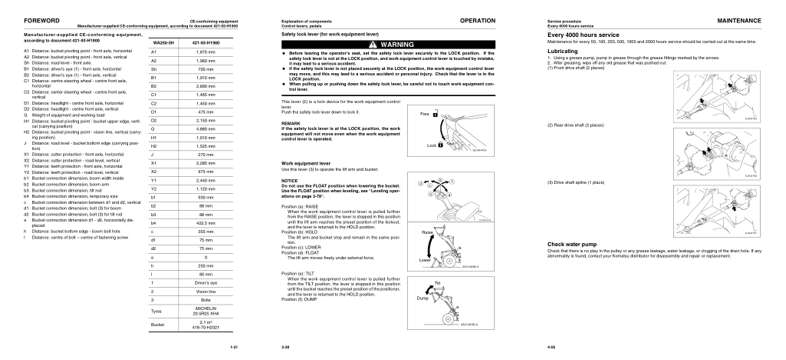
- Specifications, page 24: FOREWORD
- Controls and operation, page 99: Explanation of components
- Maintenance, page 225: Service procedure
This is an operator's manual
Here's how it compares to the other manual types.
Service manual
Factory repair procedures and technical information such as specifications, troubleshooting, and wiring and hydraulic diagrams, for the models and systems the manual covers. See What's inside for its topics.
Operator's manual
Safe operation, controls, maintenance schedules, lubrication points, inspections, and basic checks. Repair procedures are in the service manual.
Parts manual
Illustrated diagrams with factory part numbers for identifying components and ordering parts. Repair procedures are in the service manual.
What it's used for
Factory manual for in-house farm and construction shop use. Straightforward, complete, and easy to follow. It contains the OEM information dealership service departments and parts counters use to diagnose problems, identify components, and perform maintenance or repairs correctly.
Service shops and owner/operators who repair their own equipment
Identifying correct parts and seeing how assemblies come apart and go back together
Keeping equipment running with less downtime
Factory manual, 246 pages
Quantity one is the manual described above.
Fast free USA shipping
Ships in 1 business day.
60-day returns
Free if the mistake is ours. A manual ordered in error must come back unopened in its shrink-wrap; you pay return shipping and a 20% restocking fee applies. Return policy
Other editions and similar models
Questions about model, serial number, engine coverage or contents? Contact us before purchasing and we'll help confirm it's the right manual. Please verify the manual type, machine model, serial number range and engine coverage before purchasing: manuals ordered in error carry a 20% restocking fee (return policy).