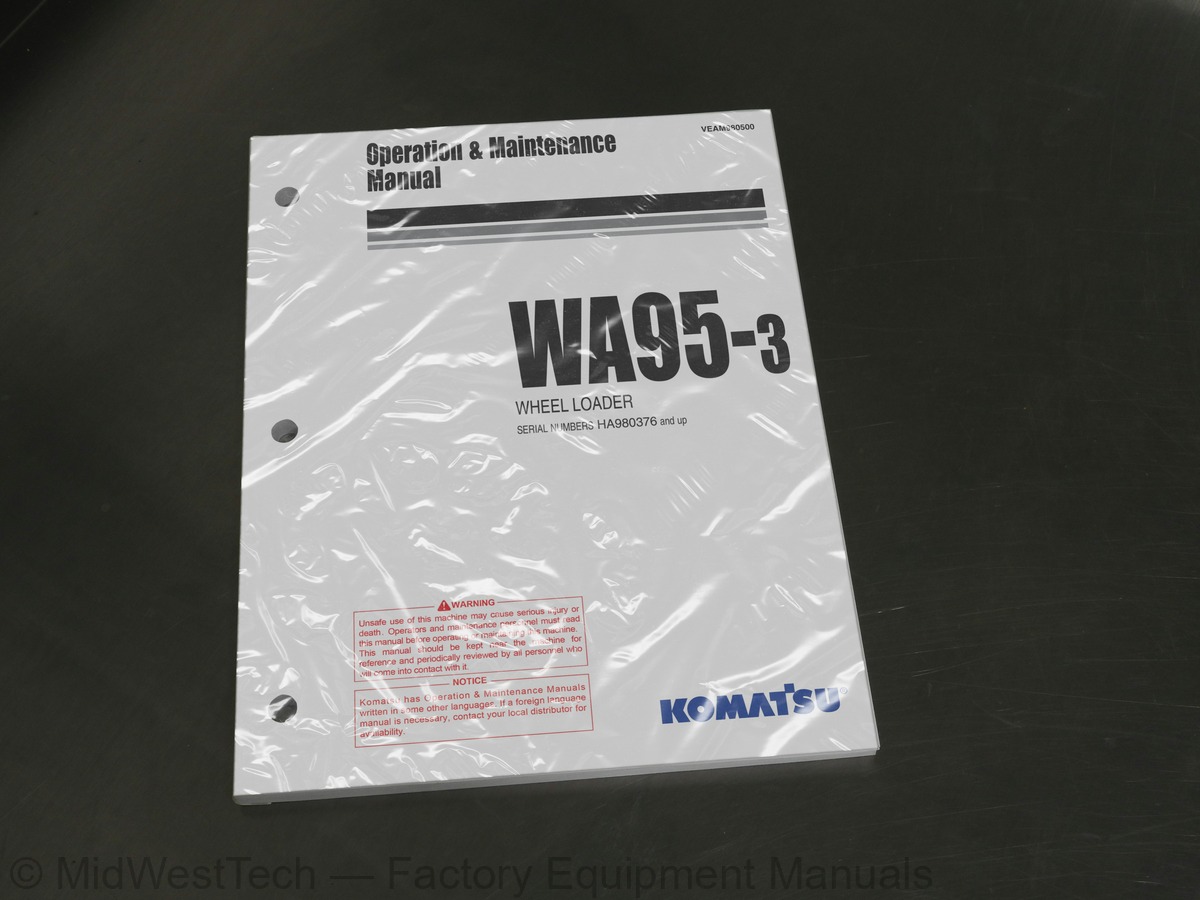
Komatsu WA95-3 Wheel Loader Operation & Maintenance Manual
199 pages · Publication VEAM980500
Added to your cart. View cart
- Models
- WA95-3
- Serial coverage
- HA980376 and up
- Manual type
- Operation & Maintenance Manual
- Pages
- 199
- Publication
- VEAM980500
- Condition
- Brand new
What's inside
From the manual's own table of contents: 204 topics. See sample pages (PDF, 415 KB)
- Information on these Operating Instructions
- Why You Should Read these Operating Instructions
- Notes on Safety Regulations
- Correct Use
- Safety Notes in the Operating Instructions
- Standards and Guidelines
- CE-Conforming Equipment
- CE-Conforming Equipment of the Manufacturer According to Document 42W-93-11130
- Loading and Transporting the Machine
- Securing the Articulated Steering
- Lifting the Machine
- Driving Machine Onto Loading Area of Transport Vehicle
- Securing the Machine During Transport
- After Transport
- Dimensions, Weights, and Operating Values
- Technical Data
- Safety
- General Safety Measures
- Safety Instructions
- Safety Devices
- Emergency Exit
- Clothing and Personal Protection
- Machine Modifications
- Before You Leave the Driver's Seat
Show all 204 topics
- Mounting and Dismounting
- Fire Prevention and Fire Fighting
- Protection Against Asbestos Dust
- Protection Against Injuries
- Working at High Temperatures
- Roll-Over Protection System (ROPS)
- Attachment for Protection Against Falling Objects (FOPS)
- Attachments
- Battery
- Before You Start the Engine
- Workplace Safety
- In the Driver's Cab
- In-Door Operation
- Gas, Dust, and Inflammable Vapours
- Mirrors, Windows, and Lighting
- Machine Operation
- Reversing
- Driving
- Driving On Slopes
- Emergency Lowering System
- Working Close to Overhead Power Transmission Lines
- Loading
- Good Vision
- Working On Snow
- Height Limitation
- Brakes
- Working On Loose Soil
- Working with the Forklift Truck Attachment
- Parking the Machine
- Transport
- Loading and Unloading the Machine
- Safety Measures During Maintenance
- Personnel
- Prior to Start of Maintenance Measures
- During Maintenance
- Tyres
- Labeling
- Positions of Safety Labels
- Information Labels
- Controls and Indicators
- Overall View of the Machine
- Overall View
- Instrument Panel
- Warning Lights
- Control Lamps
- Measuring Indicators
- Switches
- Control Levers, Pedals
- Articulated Steering Catch
- Traction Device
- Socket
- Door Unlocking System
- Alarm Horn for Reverse Driving (Option)
- Operation
- Running in the Machine
- Preparing the Machine Start
- Visual Checks (also refer to chapter "Maintenance Prior to Machine Start")
- Adjustments Prior to Machine Start
- Adjusting the Driver’s Seat
- Adjusting the Steering Column
- Adjusting the Armrest
- Adjusting the Rear-View Mirrors
- Adjusting the Heating and Ventilation System
- Operating the Air Conditioning
- Putting on the Safety Belt
- Starting and Switching Off the Engine
- Starting the Engine
- Switching Off the Engine
- Start-Up
- Driving with the high-speed gear
- Changing the Driving Direction
- Reverse Driving
- Turning
- Braking
- Stopping
- Longer-Distance Driving
- Operating the Machine
- Tyre-Appropriate Operation
- Adjusting the Bucket Positioner
- Transporting
- Dumping/Unloading
- Planing
- Precautions For Special Operations
- After the work is finished
- Instructions for Winter Operation
- Longer Standstill Periods of the Machine
- Troubleshooting
- Warning Lights and Indicators
- Electrical System
- Engine
- Hydraulic System
- Axles
- Driver's cab
- Emergency Steering Characteristics
- Starting the Engine with a Battery Jumper Cable
- Towing the Machine
- Inadequate Braking Effect
- Maintenance
- Maintenance Basics
- Cleaning the Machine
- Working-Area-Dependent Maintenance
- Lubricants and Operating Agents
- Replacing Safety-Related Parts
- Spare Parts and Consumable Components
- Tools
- Torque for Standard Nuts and Bolts
- Maintenance Schedule
- Maintenance Prior to Start
- Cooling System, Checking the Coolant Level, Topping Up Coolant
- Engine, Checking the Oil Level, Topping Up Oil
- Engine, Draining Off Oil
- Checking the Fuel Level, Refuelling
- Checking the Controls
- Checking the Electrical Connections
- Heater / Air conditioning: checking rate of air flow
- Other Maintenance Measures Prior to Start
- Maintenance upon Demand
- Checking the Air Conditioning System
- Maintenance Every 10 Operating Hours
- Lubrication
- Maintenance After the First 50 Operating Hours
- Engine, Changing Oil and Replacing the Oil Filter Cartridge
- Replacing the Oil Filter Cartridge
- V-Belt, Checking the Condition
- V-Belt, Checking and Adjusting the Tension
- Hydraulic System, Replacing the Filter Insert
- Checking and Tightening the Wheel Nuts
- Front and Rear Axle, Oil Change
- Transfer Box Gearing - Changing Oil
- Maintenance Every 50 Operating Hours
- Checking the Cooling System, Coolant Level in the Radiator and expanion tank
- Draining Off Water and Dirt Deposits From the Fuel Tank
- Checking the Service Brake and Oil Level, Refilling Oil
- Checking the Battery and Acid Level
- Re-Charging the Battery
- Maintenance Every 100 Operating Hours
- Draining the Water Separator, Removing Water and Dirt Deposits
- Maintenance Every 250 Operating Hours
- Changing the Engine Oil and Oil Filter Cartridge
- Checking the V-Belt Condition
- Checking and Adjusting the V-belt Tension
- Front and Rear Axle, Checking the Oil Level
- Air Filter, Removing and Re-Installing the Filter Insert, Checking and Cleaning the Filter Insert
- Cleaning the Radiator Segments
- Maintenance Every 500 Operating Hours
- Changing the Fuel Filter and Filter Element
- Changing the Filter Cartridge of the Hydraulic System
- Cleaning the Water Separator
- Transfer Box Gearing, Checking the Oil Level and Refilling Oil
- Air Filter, Replacing the Filter Insert, Replacing the Safety Filter
- or cleaning Condenser
- Checking the ALS-Accumulator Gas Pressure (Option)
- Maintenance Every 1000 Operating Hours
- Cooling System, Exchanging Coolant and Cleaning the System
- Front Axle, Oil Change
- Rear Axle, Oil Change
- Transfer Box Gearing, Oil Change
- Service Brake
- Checking and Adjusting System Pressures
- Checking and Adjusting the Valve Play
- Checking and Adjusting the Injection Nozzles, Nozzle Pressure and Fuel-Jet Pattern
- Checking the Accumulator Gas Pressure of third Control Circuit
- Maintenance Every 2000 Operating Hours
- Hydraulic System, Oil Change
- Ventilating the Hydraulic Oil Tank
- Cooling System, Checking the Antifreeze Content of the Coolant
- Checking the Cooling System
- Checking the Fuel Pump
- Checking the Fuel and Coolant Tubes, Replacing the Tubes (if required)
- Checking the Water Pump
- Checking and Adjusting the Fuel Injection and Injection time
- Noise Emission Levels
- Vibration Level
- Limit Values for Slopes
- Special Equipment and Attachments
- ALS-Electronics
- Structure and Functioning Principle of the ALS-Electronics
- Precautionary Measures for Switching on the ALS-Electronics
- Operation of the ALS-Electronics
- Handling of the Pressure Accumulator
Inside this manual
Real pages from this operation & maintenance manual (199 pages). Open the sample pages (PDF, 415 KB)

- Specifications, page 25: Loading and Transporting the Machine
- Controls and operation, page 61: Controls and Indicators
- Maintenance, page 157: Maintenance After the First 50 Operating Hours
Other manuals for this machine
Save 10% on 2 manuals, 15% on 3 or more. Other manuals for the WA95-3 are listed below. Editions cover different serial number ranges: check the serial coverage and tick only the ones that match your machine.
Added to your cart. View cart
This is an operator's manual
Here's how it compares to the other manual types.
Service manual
Factory repair procedures and technical information such as specifications, troubleshooting, and wiring and hydraulic diagrams, for the models and systems the manual covers. See What's inside for its topics.
Operator's manual
Safe operation, controls, maintenance schedules, lubrication points, inspections, and basic checks. Repair procedures are in the service manual.
Parts manual
Illustrated diagrams with factory part numbers for identifying components and ordering parts. Repair procedures are in the service manual.
What it's used for
Factory manual for in-house farm and construction shop use. Straightforward, complete, and easy to follow. It contains the OEM information dealership service departments and parts counters use to diagnose problems, identify components, and perform maintenance or repairs correctly.
Service shops and owner/operators who repair their own equipment
Identifying correct parts and seeing how assemblies come apart and go back together
Keeping equipment running with less downtime
Factory manual, 199 pages
Quantity one is the manual described above.
Fast free USA shipping
Ships in 1 business day.
60-day returns
Free if the mistake is ours. A manual ordered in error must come back unopened in its shrink-wrap; you pay return shipping and a 20% restocking fee applies. Return policy
Other editions and similar models
Questions about model, serial number, engine coverage or contents? Contact us before purchasing and we'll help confirm it's the right manual. Please verify the manual type, machine model, serial number range and engine coverage before purchasing: manuals ordered in error carry a 20% restocking fee (return policy).